SRA Audits in London
Millet Audit are a leading accountancy company, specialising in financial and statutory audits.
Get in Touch

Millet Audit are a leading accountancy company, specialising in financial and statutory audits.
Get in TouchIf your firm receives or holds client money during the accounting period, you are likely required to obtain an annual accountant’s report under the Solicitors Regulation Authority’s Accounts Rules. Even if your firm qualifies for an exemption from submitting a report to the SRA, it is still your responsibility to assess this accurately, maintain good records, and demonstrate that your systems are adequate. Many London firms also choose to undergo an SRA audit voluntarily, particularly when expanding services or managing higher volumes of client funds.
Speak to our team and we’ll review your position, help determine whether a report is needed, and guide you through the process. We examine how client money is received, held, and disbursed, and assess whether your firm’s internal procedures align with the SRA’s rules — all while keeping disruption to your day-to-day legal work to a minimum.
SRA audits play a vital role in ensuring that law firms across London remain compliant with the Solicitors Regulation Authority’s Accounts Rules. At Millet Audit, we specialise in helping legal practices across the capital prepare for and navigate SRA audits with confidence. Whether you’re a boutique legal practice or a multi-office firm, understanding your obligations under the SRA’s regulatory framework is essential — and that’s where we come in.
London is home to thousands of solicitors and legal professionals, all of whom must comply with the high standards expected by the SRA. Keeping up with the ever-changing regulatory landscape can be a challenge, especially while balancing the day-to-day demands of running a law firm. Our experienced team provides tailored support, ensuring that your accounting systems, procedures, and client money handling are in line with the current SRA Accounts Rules.
We understand the unique financial and regulatory pressures facing legal professionals in London. With our support, your firm can meet its compliance obligations while maintaining smooth, uninterrupted operations. Our approach is professional, efficient, and always focused on giving you peace of mind.
Get in Touch


An SRA audit is an independent check carried out to ensure that a law firm is complying with the Solicitors Regulation Authority’s Accounts Rules. These rules govern how solicitors handle client money, maintain proper records, and safeguard funds entrusted to them. SRA audits are not just about ticking boxes — they are a key part of building trust with clients and demonstrating that your firm operates with integrity and transparency.
Firms are typically required to obtain an accountant’s report if they have held or received client money during the accounting period. The report must be prepared by a qualified reporting accountant who is independent of the firm and registered with a recognised supervisory body. If breaches of the rules are identified, they may need to be reported to the SRA, particularly where they are deemed material or repeated.
At Millet Audit, we are experienced in conducting these specialist audits. We take the time to understand your systems, identify any areas of concern, and work with you to correct them — all while keeping disruption to a minimum.
Contact Us TodayNot every law firm is automatically required to submit an accountant’s report to the SRA. However, if your practice receives or holds client money — even for a short time — you are likely to need an annual SRA audit. The current SRA Accounts Rules place a greater emphasis on judgement and risk, so even if your client money activity is limited, you still need to ensure you are compliant and can demonstrate that your systems are adequate.
Even if your firm ultimately qualifies for an exemption from submitting a report to the SRA, it is still your responsibility to assess this accurately and maintain good records. Many firms in London choose to undergo an SRA audit voluntarily as a safeguard, particularly when expanding services or managing higher volumes of client funds.
Our team can review your position and help determine whether a report is needed. If it is, we will carry out the audit efficiently and in line with all professional requirements. If you are exempt, we can still provide a review of your systems to help you stay on track.
Get in Touch


Regulated by

We’re committed
Everything we do we do with the upmost integrity

We will ensure we understand your business
We will work with you to deliver an efficient audit
We organise ourselves so that we can best balance life and work
We are committed to developing our team
We want our team to progress and reach their maximum potential
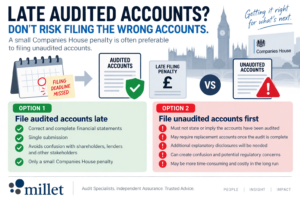
Late Filing of Audited Financial Statements Missing a Companies House filing deadline is never ideal. Directors are understandably keen to avoid late filing penalties, particularly where the accounts are only days...

Valuing Share Options in Private Companies: Methods and Audit Considerations Introduction Many private companies use share option schemes to attract, motivate and retain key employees. Whether the scheme involves EMI options,...

The signed audit report is the public outcome of a charity audit, but it is not always the document that drives the most operational improvement. Auditors often issue a separate management...

One of the first questions asked by a charity preparing for an audit is what documents the auditor will need. The simple answer is that the evidence must support the figures,...

Preparing for a charity audit is easier when it is treated as a project with owners, milestones and review time. The work should not begin when the auditor sends the first...

Charity audits sit at the meeting point between financial reporting, governance and public trust. For trustees, chief executives and finance teams, the process is not simply an annual inspection of the...

Revenue Recognition for Small Charities: For many small charities, income recognition has traditionally been one of the most challenging areas of financial reporting. Trustees often need to determine whether grants, donations,...

FRS 102 Revenue Recognition Changes: Executive Summary The amendments to FRS 102 effective for accounting periods beginning on or after 1 January 2026 represent one of the most significant changes to...
Understanding SORP 2026 and the New Charity Accounting Thresholds – The New Era of Charity Accounting and Reporting Executive Summary The UK charity sector is experiencing the most significant change to...
The SRA audit process typically begins shortly after the end of your accounting period. At Millet Audit, we aim to make the process as clear and straightforward as possible. We’ll start by gathering key financial records, reviewing how client money is received, held, and disbursed, and assessing whether your firm’s internal procedures align with the SRA’s rules.
We look at areas such as how promptly client funds are banked, whether reconciliations are done regularly and accurately, and whether any transfers between client and office accounts are properly documented and authorised. Our role is not just to spot errors, but to provide insight and recommendations that help you avoid issues in the future.
If any breaches are identified, we will discuss them with you clearly and constructively. If the issues are minor and already resolved, they may not need to be reported. Where reporting is required, we will guide you through the process, ensuring that everything is handled properly and in a way that protects your firm’s reputation.


SRA compliance is not just a regulatory requirement — it’s also about protecting your clients and the reputation of your firm. London is one of the most competitive legal markets in the world, and clients rightly expect law firms to handle their funds with absolute care and precision. A clean SRA audit helps build trust with clients, lenders, and insurers, and demonstrates that your firm operates at the highest professional standards.
Failing to comply with the Accounts Rules can lead to serious consequences, including regulatory action, financial penalties, and reputational damage. The SRA has the power to intervene in serious cases, which can have far-reaching implications for the firm and its clients. That’s why regular, independent SRA audits are not just a box to be ticked — they are a vital part of risk management and good governance.
Working with a team like Millet Audit ensures that your firm remains compliant, proactive, and prepared for any regulatory scrutiny. We help you implement best practices, close any gaps in procedures, and keep your accounting systems robust and audit-ready. Contact us today.
An SRA audit is designed to ensure that law firms are managing client money in line with the Solicitors Regulation Authority (SRA) Accounts Rules. These rules exist to protect the public and uphold trust in the legal profession. During an audit, an independent reporting accountant examines how client funds are handled, checking whether proper records are maintained and whether any breaches of the rules have occurred. The audit aims to confirm that client money is clearly separated from the firm’s office funds, that all transactions are properly authorised, and that reconciliations are carried out regularly. A clean audit helps reassure clients, insurers, and regulators that the firm is acting professionally and responsibly. For firms operating in a competitive legal market like London, maintaining a strong compliance record is essential for protecting reputation and ensuring long-term success. An audit can also highlight areas where internal processes can be improved for added security and efficiency.
Not every law firm is required to submit an SRA accountant’s report. Whether your firm needs one depends on how you handle client money. If your firm receives or holds client funds during the accounting period, it is highly likely that you’ll need to commission an SRA audit. However, there are exemptions for firms that hold client money only in limited circumstances, such as where all money received is for disbursements paid on behalf of the client and is passed on within a short timeframe. Despite the exemption rules, it is still the firm’s responsibility to assess their situation accurately. Many firms in London choose to undergo an audit voluntarily, even if they qualify for exemption, to reassure their clients, trustees, or insurers. Working with an experienced reporting accountant can help determine whether your firm falls within the reporting requirement, and if not, whether a voluntary audit might still be beneficial for governance and reputation purposes.
An SRA auditor focuses on how your firm receives, handles, records, and transfers client money in accordance with the SRA Accounts Rules. This includes reviewing whether funds are kept in appropriate client accounts, ensuring that transfers between office and client accounts are clearly documented and properly authorised, and checking that financial records are up to date and accurate. The auditor will look at reconciliations of client accounts, review a sample of client transactions, and evaluate whether internal controls are strong enough to prevent error or misuse. Particular attention is given to any breaches of the rules, whether these have been corrected, and how the firm has responded. For London-based law firms with complex structures or multiple departments, auditors may also assess how policies are implemented across the organisation. The audit process helps identify risks, ensures that your firm is safeguarding client money properly, and provides an opportunity to strengthen procedures where needed.
If an SRA auditor identifies a breach of the Accounts Rules, they will assess whether the breach is material and whether it must be reported to the SRA. Not every breach leads to formal reporting. Minor breaches that have been corrected promptly and don’t indicate a wider issue may be documented but not escalated. However, if the breach is serious, repeated, or suggests systemic weaknesses in how client money is handled, the auditor is obliged to include it in the accountant’s report to the SRA. This does not necessarily mean regulatory action will follow, but the SRA may ask the firm for further information or require corrective measures. For law firms in London, where reputational damage can have long-lasting consequences, it’s crucial to address any issues as soon as they arise. At Millet Audit, we work with firms to rectify problems quickly and put processes in place to prevent similar breaches in future audits.


