
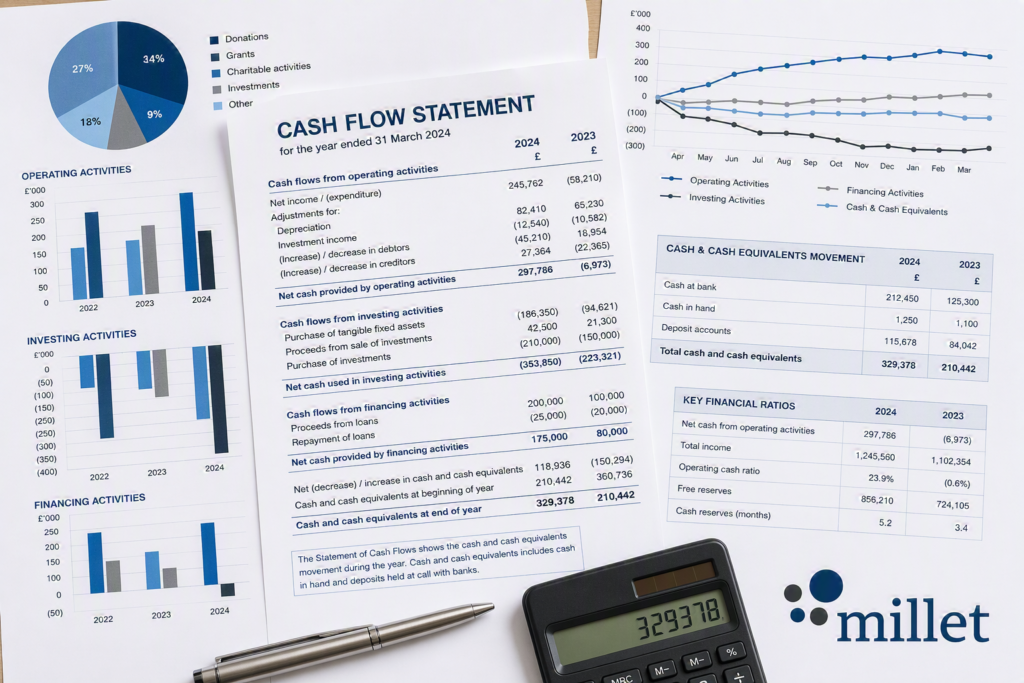
Charity Cash Flow – this is going to be contentious: For many charities preparing accounts under the Charities SORP, the statement of cash flows has become a familiar feature of the annual report. Larger charities are required to include one, while smaller charities may choose to do so voluntarily. The stated objective is straightforward: to help users understand how cash has moved through the organisation during the year and to assess liquidity and solvency. The Charities SORP itself notes that cash flow information can assist funders in understanding a charity’s financial position and cash management. [charities-…s102-2019a | PDF]
However, despite these intentions, it is worth asking a more challenging question:
How useful is the Charity Cash Flow to the average reader of charity accounts?
Charity Cash Flow – A Statement Few People Truly Understand
In our experience, the vast majority of readers of charity accounts focus on three areas:
- The Trustees’ Annual Report
- The Statement of Financial Activities (SoFA)
- The Balance Sheet
These sections tell most readers what the charity has achieved, how much income it has received, what it has spent, and what resources remain available at the year-end.
The statement of cash flows, by contrast, is often one of the least understood sections of the accounts. Terms such as “reconciliation of net income to net cash flow from operating activities”, “investing activities” and “financing activities” are familiar to accountants but can be confusing to trustees, donors and beneficiaries.
Many trustees struggle to interpret what the statement is actually telling them. A charity may report a positive cash inflow whilst simultaneously generating an accounting deficit, or vice versa. Whilst accountants understand the reasons for these differences, many users do not.
As a result, the cash flow statement can become a technical compliance exercise rather than a genuinely useful communication tool.
Charity Cash Flow – Does It Really Tell Us Anything New?
One of the biggest criticisms of the statement of cash flows is that it frequently repeats information already available elsewhere in the accounts.
For example:
- Income is already disclosed within the SoFA.
- Expenditure is already analysed in detail within the SoFA and notes.
- Cash balances are already shown on the balance sheet.
- Changes in reserves are already apparent from the funds note and SoFA.
The cash flow statement often takes these figures and simply rearranges them into a different format.
For many charities, particularly those with straightforward operations, the statement rarely reveals anything that an informed reader could not already establish from the SoFA and balance sheet.
Indeed, a reader wanting to know whether a charity’s financial position has improved will often find the balance sheet and reserves disclosures far more informative than a page of cash flow reconciliations.
More Pages, More Complexity
Charity accounts have become increasingly lengthy over the last decade.
Additional regulatory disclosures, governance requirements, reserve policies, risk management disclosures and detailed fund reporting have all added to the size of annual reports.
Against this backdrop, the cash flow statement can feel like another layer of complexity that adds pages without necessarily adding insight.
For smaller and medium-sized charities, users may legitimately question whether a further page of technical accounting analysis enhances transparency or simply increases the volume of information that stakeholders must navigate.
The reality is that many readers never reach the cash flow statement at all.
There Are Circumstances Where Charity Cash Flow Matters
That is not to say cash flow information has no value.
For charities undertaking significant capital projects, carrying substantial borrowings, making major investments or managing tight liquidity positions, cash flow analysis can be important.
Lenders, sophisticated funders and finance professionals may place considerable reliance on cash flow information when assessing a charity’s ability to meet future obligations.
The Charities SORP itself recognises the value of cash flow reporting in assessing a charity’s solvency and financial resilience. [charities-…s102-2019a | PDF]
However, these users are often the exception rather than the rule.
A Better Alternative? Charity Cash Flow
Rather than relying on a highly technical cash flow statement, many charities might provide greater value through enhanced narrative reporting.
A concise explanation from trustees covering:
- Cash reserves at year-end;
- Liquidity considerations;
- Future funding commitments;
- Financial risks and uncertainties; and
- Expected cash requirements over the next twelve months
may be significantly more understandable for readers than a formal statement of cash flows.
Transparency is not simply about providing more information; it is about providing information that users can genuinely understand.
Final Thoughts on Charity Cash Flow
The statement of cash flows undoubtedly has technical merit and remains a requirement for many charities under the Charities SORP. Yet its practical usefulness is open to debate.
For most readers, the key messages about financial performance and financial position can already be found within the Trustees’ Report, SoFA and Balance Sheet. The cash flow statement often restates that information in a more complex format, increasing the length of the accounts without necessarily improving understanding.
Perhaps the real challenge for charity reporting is not whether more accounting disclosures should be included, but whether the information presented genuinely helps trustees, donors and beneficiaries understand the financial health of the organisation.
At Millet Audit, we believe charity accounts should do more than comply with regulations—they should communicate clearly, transparently and meaningfully with the people who rely on them.
Should you need help with this subject please get in touch with us info@milletaudit.com
Useful source of information: https://www.gov.uk/government/organisations/charity-commission